Lending our voice to important trail issues

In April, the STA wrote two letters of support relating to issues concerning trails in the provinces. This occurred after our AGM, where members voted that the STA should lend its voice to support trail development.

We wrote a letter to letter to the Minister Responsible for SGI to voice our support to create an effective ATV registration system in the province. The STA feels that requiring registration of ATVs would enable authorities and residents to efficiently identify ATVs, leading to effective enforcement of provincial regulations regarding the illegal operation of ATVs on public roads and public lands, and improved identification and recovery of stolen ATVs.

We received the following response:

SGI Response

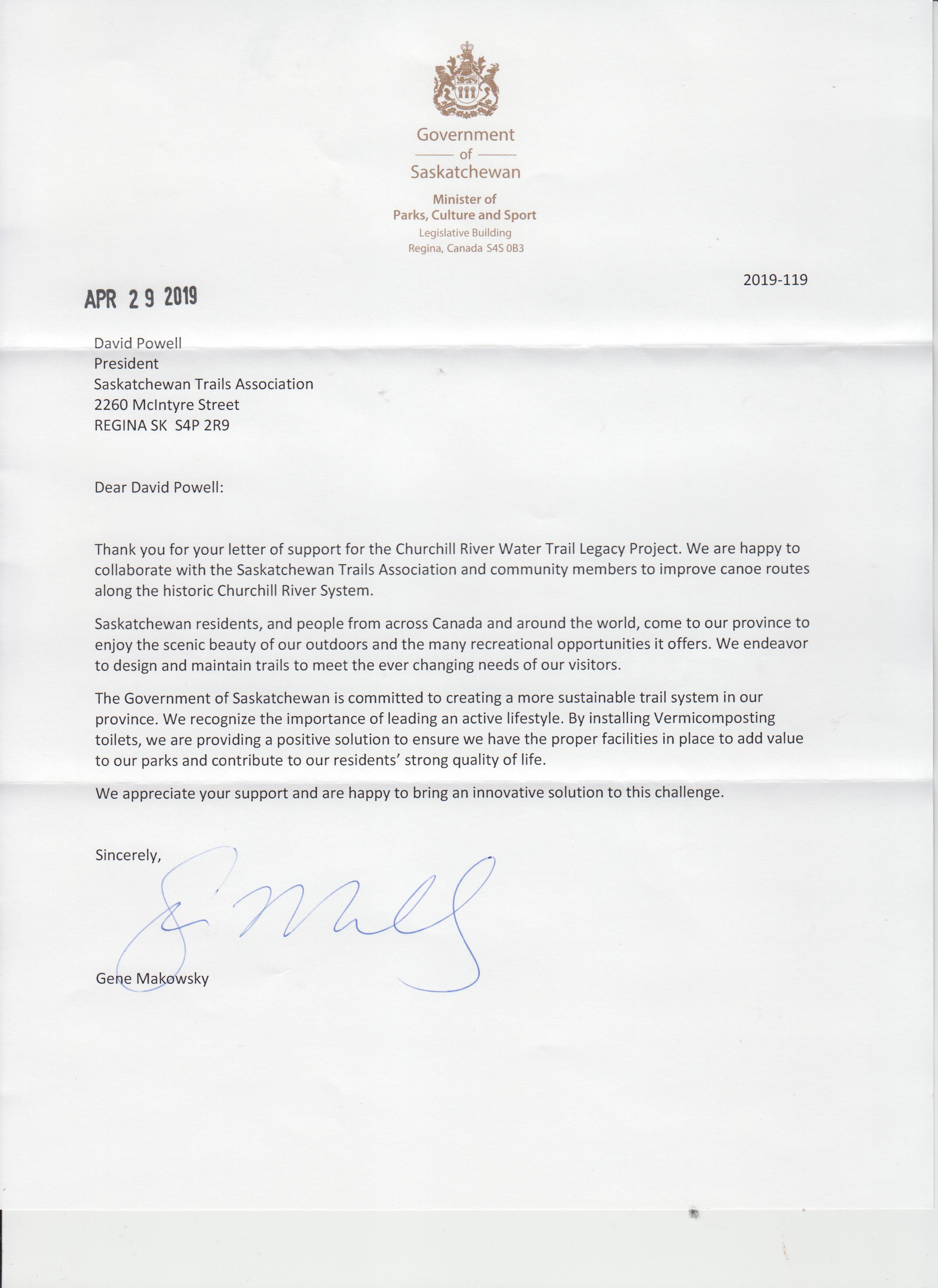
The STA also wrote a letter of support to the Minister of Parks, Culture and Sport to applaud the Churchill River Water Trail Legacy Project sustainability project that will see vermicomposting toilets installed in northern canoe routes to effectively deal with the problem of human waste.

We received the following response:

Response Letter - Churchill River Water Trail Legacy Project

How not to train for a long run in the mountains

By Russell Hodgins

  1. Travel to Saskatoon.
  2. Forget to bring your hydration pack.
  3. Also forget to bring a water bottle.
  4. Be short on time and tell yourself you can’t go pick up a bottle of fluid.
  5. Go for a long run on the amazing trails that travel along the riverbank.
  6. Be thankful that it was a cool day and then return extremely dehydrated.
  7. Drink any fluid you can find for the next 24 hours.

The run started on the paved trails at the University of Saskatchewan and very quickly, there’s an option to get off road. What followed was a series of well packed dirt trails in a rollercoaster of ups and downs. There were multiple trails so at times, I climbed up to enjoy the views and then dropped down to the river flats where I was running in the sand. The turnaround point was at the Peggy McKercher Conservation Area and just before that, is an excellent mountain bike trail that travels near the top of the river valley before dropping down and looping back closer to the river. Closer to the city, I met several people out walking their dogs along with some very courteous bike riders. Farther out, it was mostly people with backpacks getting ready for summer outings I assumed.

Image 1

Just before the Conservation Area, my wanderings had me on deer trails but the better option would have been to stay on the actual trails.

Image 2

Image 3

Image 4

Never let common sense and good judgement get in the way of a nice run! A huge thank you to the people of Saskatoon who keep these trails in such good shape.

Running the Trails in Saskatchewan

By Nicole Williams

Trail running is quickly gaining traction in the province as runners look to move off the road and into the great outdoors.

This sport involves running on any off-road surface, such as coulees, fields, forests, hills or dirt paths. The benefits include less strain and stress on your body, particularly your lower back and glutes, as you’re running on softer, more forgiving terrain than asphalt and cement. The changing landscape also increases the development of lesser-used stabilizing muscles, resulting in less repetitive movements and less risk of developing injuries that are common in road running.

Other added benefits include running in fresh air, which is better for overall lung health, and stress reduction from being away from the city, focusing less on home and work, and more on exploring the natural world around you.

Little equipment is required to get started. Road running shoes can be used; however, if you plan on spending any amount of time on the trails, you may want to buy a pair of trail running shoes. These shoes are designed to grip the softer terrain found on trails, are lower to the ground for better stability, and contain an extra layer that protects your feet from rock and other puncture wounds.

Trail runners will need to carry extra supplies with them to deal with the new challenges that comes with running off-road. You will want to invest in a comfortable, lightweight backpack to carry essential supplies such as a water bottle, bug repellent, food, sunscreen, GPS or compass with a map, a headlamp (if running at dusk or night) and basic first aid supplies like band aids.

Developing a safety strategy is a must. Before heading out on the trails, let someone know your route and when you expect to return. You should also carry a cell phone in case of an emergency, and try to run with at least one other person. You may want to join a running group, such as the Regina Road Runners Club or the Saskatoon Road Runners, for the benefit of group trail runs and events in your area.

The following are just a few of the running trails you’ll want to check out this year.

Beaver Flat 50 Course, Saskatchewan Landing Provincial Park, is one of the most grueling running trails in the province. Its 50 km course features more than 2,300 metres of vertical climbs, narrow paths, cacti, sand and wet conditions, and it boasts the appropriate hashtag: #anythingbutflat. According to the group’s website, “You’re going to love it, hate it, and love it some more. Guaranteed.”

Deadfall 50 Course, Echo Valley Provincial Park, winds through the Qu’Appelle Valley along narrow trails and expansive pastures, providing breath-taking views and challenges for runners of every level: https://deadfall50.ca

The Wascana Valley Nature Recreation Site, aka Wascana Trails, offers 15 kms of exceptional Qu’Appelle Valley trails and scenery. Trail markers lead runners through pathways that boast winding, sharp descents, steep inclines, gradual hills and other obstacles and challenges that will leave you wanting to return again and again: https://www.tourismsaskatchewan.com/search-results/105290/regina—wascana-valley-trails.

Buffalo Pound Provincial Park hosts the annual Prairie Summit Run-It Trail Race course, which features challenging hills, woodlands, and open grassland pathways, providing exceptional vistas for all trail users to enjoy: https://www.tourismsaskatchewan.com/provincialpark/303/buffalo-pound-provincial-park#sort=relevancy.

Remember, trail running is quite different from road running. You will not be able to run at the same pace on a trail as you do on a paved surface, so don’t focus on how many kilometers you’ve covered, but rather on your total time on the trails. Don’t be afraid to walk; steep inclines, rocky paths and hills are more challenging, and it’s okay to slow down and hike these areas. Falling is part of the experience, but as you get used to the off-road conditions, you will fall less. And, always be considerate to others on the trail: take out what you bring in, share the path, think of others, and don’t forget to stop and enjoy the view along the way.

Get off the beaten path; explore Saskatchewan’s running trails today!

Fat Biking trail takes off thanks to STA support

7
Photo courtesy of Frank Collins of Danger Dynamite Multimedia

Earlier this year, the Fatlanders Fat Tire Brigade received a $1,000 Member Grant from the STA to support their Winter Fat Bike Groomed Trail Network called the St. Barbe Winter Trail Network. A fat bike is an off-road bicycle with oversized tires, typically 3.8 in (97 mm) or larger and rims 2.16 in (55 mm) or wider, designed for low ground pressure to allow riding on soft, unstable terrain, such as snow and sand.

Fatlanders had two goals with the project: 1) To create a well signed and reliably groomed winter trail network in an under-utilized urban forest on the outskirts of Saskatoon; 2) To maintain, prepare, and further develop the trail network for the 2018-19 season.

The grant helped the club create 600m of new single track trail this year, bringing the groomed winter trail network to over 12km.  The amount of use the trail network is getting has demonstrated that winter recreational cycling can be a viable and enjoyable activity in Saskatoon for riders of all abilities.

The club is now better positioned to continue to grow and maintain the trail network. Its membership has grown 50 per cent over this time last year and many new riders are being introduced to winter riding thanks to the success of these trails. The membership has been validating their appreciation by donating over $1,000 since January through the Trailforks mapping mobile app and a further $1,400 at a fundraiser held Dec 2, 2018. These funds will be used to further enhance the clubs’ ability to operate, groom, and sustain the trails for 2018-19 season.

“Thank you to the Saskatchewan Trails Association for the Member Grant of $1,000 that helped us to create 600m of new trail and achieve our 2018 goals of establishing an awesome winter recreational area for the emerging sport of fat biking,” said Jeff Hehn, vice president/trail ambassador for FatLanders Fat Tire Brigade.

To learn more about the trail, visit http://sasktrails.ca/trail-directory-saskatoon.

Check out this video from the Dec.1 group ride in Saskatoon as part of Global Fat Bike Day: a world wide celebration of the emerging sport. There were 98 riders who took part: https://bit.ly/2Eko50o

STA releases 2019-2024 Strategic Plan

The STA’s 2019-2024 Strategic Plan will allow us to focus our efforts to fulfill our mission and achieve our vision.

We have developed four strategic priorities:

1. Continue to be an effective and well-governed board.
2. To be a resource for accurate trail location and operational information accessible to the public and
the membership.
3. To move into greater alignment with the National Recreation Framework and the priorities of the
recreation section of the Saskatchewan Lotteries Trust Fund.
4. To effectively support and grow the membership.

VIEW THE ENTIRE DOCUMENT

Travel back in time through these Sask historical tours

IMG_2149 (2)

There are trail outings in Saskatchewan that allow residents to take a walk back in time. Numerous towns and villages have developed walking tours that highlight some of the historically significant features of their neighbourhood. On these walking tours, you’re likely to encounter historic churches, rustic barns or old railway lines that once played a significant role in the community’s livelihood.

Here are some great historic walking tours you can take part in:

Whitewood Heritage Walking Tour: the Whitewood Heritage Walking Tour is an award-winning tour that features 30 historical buildings and heritage sites in the community. Some of the sites include the Knox Presbyterian Church, the Merchant’s Bank Heritage Centre, the Whitewood Cemetery, the town’s first post office, the local Cenotaph, the Market Day Mural, and the Old Presbyterian Manse. For more information. visit www.townofwhitewood.ca.

Wolseley Heritage Tour: features 36 historical buildings, including several designated municipal and provincial heritage sites. Some of the buildings that you will see along the tour are the Historic Swinging Bridge, a home that was once an RCMP barracks complete with a jail cell, the St. Anne’s Roman Catholic Church, the Wolseley Town Hall/Opera House, a house that was once visited by members of the Co-operative Commonwealth Federation (CCF) – including Tommy Douglas, M.J. Coldwell and J.S. Woodsworth – and the Wolseley Court House. For more information, visit www.wolseley.ca.

Regina Tours: the capital city of Saskatchewan is full of history and offers numerous walking tours to take it all in. The “Wascana Lake and its sporting and political history” tour allows people to walk around the lake and hear some of the intriguing tales surrounding it. The Regina Cemetery Tour visits the graves of Regina’s politicians, police officers and soldiers, along with victims of the Regina Cyclone, Regina Riot and Spanish Influenza. For more information, visit https://heritageregina.ca/2018-summer-walking-tours/.

Radville Tours: Radville is a small valley town steeped in history. The Heritage Walking Tour allows you to take a walk back in time to the original landscape of Radville including where buildings once stood and the people who lived there. Discover the darker side of Radville through the Haunted History Tour, led by an experienced story teller and folklorist. After businesses are closed for the day and the sky is dark, walk the streets of Radville to find out stories that you would never imagine happened. For more information, visit http://radville.ca/tourism/tours-2/.

Diefenbaker Canada Centre: located at the University of Saskatchewan, you can get a valuable education in history through guided walking tours. Historical campus tours highlight the university’s history, important achievements, and unique architecture. The U of S is located on Treaty 6 territory and homeland of the Métis and you can take an Indigenous history tour that focuses on architectural and oral Indigenous histories, drawn from within the municipal and campus communities, as well as the lived experiences of Indigenous students at the University of Saskatchewan. For more information, visit https://www.usask.ca/diefenbaker/visit/Tours.php.

Does your community have a historical walking tour? Email us with the details: info@sasktrails.ca.

STA helps trail group improve snowmobile trails

Earlier this year, the Timber Trails Sno Riders Snowmobile Club was one of the groups to receive funding through the STA Member Grant program. The community service club is dedicated to maintaining and upgrading the snowmobile trail system in the Big River area.

The STA gave Timber Trails $500 toward the upkeep of their trail in Big River. This money was spent on tools and permanent signing material, such as sign posts. Check out some photos of the trail system below and visit the Lakeland District for Sport, Culture and Recreation of our Trail Directory to learn more.

28685528_1463070757152347_692203417812211838_n[1]

IMG_20170130_124303117_HDR

IMG_20170221_162155197


Be respectful of the environment during your next trail outing

82f505_78b1e8720a664211b1e404909c8b5a06

When you’re exploring a trail, there’s one type of footprint you don’t want to leave – an environmental footprint. Whether you’re on a short trail outing or camping for the weekend, your ultimate goal should be to make sure the trail area has been undisturbed by the time you pack up your things.

Here are some tips to be mindful of the environment on your next outing, sourced from Leave No Trace, an organization dedicated to promoting eco-friendly camping and hiking practices. The goal of the Leave No Trace program is to promote a consistent and unified message based around the seven Leave No Trace principles:

DISPOSE OF WASTE PROPERLY

This involves routine inspections of your campsite for any trash or food items left behind. Also, when washing dishes, be sure to use minimal water and a small amount of biodegradable soap. You should also wash dishes at least 200 feet away from lakes and streams in order to minimize the pollution from your dishes making its way into the fresh water supply.

LEAVE WHAT YOU FIND

Do your best to stay on the pre-constructed hiking trails in order to minimize the disturbance of the surrounding wilderness. Do not collect rocks, plants or other natural objects while hiking as this will disturb the natural setting of the forest.

MINIMIZE CAMPFIRE IMPACTS

The light and smoke pollution generated by campfires can have a drastic effect on the surrounding forest as well as the campers around you. When using a campfire, make sure that it is contained in a fire ring to reduce the risk of the fire spreading. Keep your fires small by utilizing only smaller sticks and branches that can easily be broken with your hands. And lastly, once the fire has burned out, allow the ashes to cool and then spread them out to minimize the effect of the fire on the forest floor.

RESPECT WILDLIFE

Although it can be exciting to see wildlife on your family camping trip , it is important that the animals are treated with respect. Never approach an animal that you come across while camping — keep a safe distance and allow the animal to carry on their normal activities. Along this same note, you should never feed animals, either by hand or by leaving food out for them to eat. This will change their natural behaviors of foraging for food and can create health problems for the animals. Lastly, if you camp with your pets, it is important to keep them under control, either on a leash or in a kennel at all times.

BE CONSIDERATE OF OTHER VISITORS

Especially when camping around other families, keep noises and voices low, respect the lights out rules specified by the campground, and be courteous at all times. When hiking, always yield to other hikers by giving them the right of way and make sure that when you stop to rest, you do it in designated areas so not to disrupt hikers who may be passing through.

PLAN AHEAD AND PREPARE

It’s always helps to prepare for inclement weather and any othe situations that might manifest while hiking outside of the designated camping areas. Be knowledgeable of your surroundings, bring a map or compass when hiking, and always pack enough food and water to anticipate any potential problems.

TRAVEL AND CAMP ON DURABLE SURFACES

When setting up a tent campsite, use the designated areas to reduce the impact on the surrounding environment. You should also utilize existing hiking trails when exploring the forest, to minimize damage done by foot traffic through the forest. Keep your campsite small — less is more when setting up a campsite and there is no need to sprawl your gear across a large area.

To learn more about Leave No Trace, visit http://www.leavenotrace.ca/home

Gear up for a great trail experience

P1050095

Packing for the climate, weather conditions, and topography is essential. In this post, we’ll review some items that you won’t want to forget on your travels. It’s better to have them and not use them (in many cases) than to need them and not have them!

One exception to this rule is the temptation to bring the kitchen sink… “just in case.” You won’t need to worry too much about bringing rope for scaling mountains in Saskatchewan, for example, so weighing yourself down needlessly will only contribute to early exhaustion. It’s important to remember that you’ll be carrying all of this on your back – both your back and your stamina have to hold out to destination and back. Remember to listen to your body at all times, and to be mindful that your back, hips, and knees are not indestructible!

We’ve put our recommendation together after scouring many sources and asking around, as well as using our own experience on the trail to guide us. You’ll want to put together a pack that works for you based on your preferences, load-bearing capacity, and hiking experience.

Let’s start with the 10 essentials for survival

1) Navigation (map and compass)
2) Sun protection (sunglasses and sunscreen)
3) Insulation (extra clothing)
4) Illumination (headlamp/flashlight)
5) First-aid supplies
6) Fire (waterproof matches/lighter/candles)
7) Repair kit and tools
8) Nutrition (extra food)
9) Hydration (extra water)
10) Emergency shelter

Most responsible hiking blogs will suggest that you pack these ten essentials for every trip, on the off-chance that you might get lost (and we’re no different!). The ten essentials list has undergone revision over the last 50 years – your grandfather’s boy scout list isn’t the same list as the one that we’ll list below, for good reason. These essentials are considered to be crucial for survival should you get lost or wounded in the woods – items like “extra water” have been added to the list now that we understand the importance of hydration. It never hurts to be prepared, even if you don’t use everything in your pack.

Here are some more areas you should focus on when packing for your next trail outing:

Appropriate clothing
Nothing can darken high spirits like being cold and wet, especially for extended lengths of time. Damp clothes (especially socks) can be more than discomfort and can lead to damaging conditions like blisters. At the extreme, wet and cold conditions can cause insulation to fail and hypothermia to set in. Are you afraid enough to do as your parents told you, and to dress warmly? GOOD. 😊 Here’s a list of ways to stay warm on the trail and to avoid discomfort and illness.

• Make sure that you prepare for the conditions to become both hotter and colder, wetter and windier. You might unexpectedly step in a mud puddle or encounter a surprise downpour.
• Cotton is to be avoided. There are many superior materials that are lighter and warmer. Synthetic fabrics are also more resilient to dampness, and will not break down like natural fibres when wet.
• What to wear/bring
– Moisture wicking t-shirt and underwear for warm weather
– Long-sleeved and long-legged bottoms for cold weather
– Extra socks (and maybe even an extra extra pair. I’ve learned to pack a thin, throwaway pair of socks “just in case”)
– Pants/shorts that dry quickly (skirts are lovely, but snag easily and leave you open to ticks. Be forewarned that jeans tend to dry somewhat slowly)
– Sun/rain hat
– Headband, bandana, or Buff (seamless, stretchy neck/headband)
– Rain jacket/slicker

Footwear
We’ll discuss foot concerns at length in another blog post. For now, it’s important that you just remember the basics to prevent you from having hurt kickers. One of the fastest ways to ruin a good trip is to develop blisters early into the trek (trust us!). You’ll add miles to your hike by bringing along good foot gear. You’ll want:
• Hiking boots or shoes (at minimum)
• Gaiters (if you expect to fish or wade through streams)
• Flipflops (in case your shoes get wet or for around the camp site)

Water
Bringing plenty of drinking water for everybody is key to happy trekkers. Even kids in carriers will need to stay hydrated. Remember, that everybody’s liquid requirements increase on hot days! Juice boxes can be a fun treat, but some hikers find them bulky and heavy to carry – your patience with carrying drinks other than water may come down to personal preference, distance, and how much other gear you have with you.

Food. So much food
Food breaks can be fun and rewarding. It isn’t uncommon for meltdowns to happen on long walks, and unhappy hikers can be distracted by cereals, crackers, dried and fresh fruit, and softer nuts like cashews that can be easily broken up. If your little one is old enough to recognize checkpoints or to understand time/distance intervals, snack breaks can be used as motivation. While we don’t advocate using food itself as a primary reward (let’s keep our relationship with food healthy!), some parents restrict certain fun foods to the trail to encourage healthier physical activity. Sugar-free gummy worms or coconut chips are a healthier alternative to higher-calorie snacks.

Tools for exploring
The types of tools that you’ll want to pack will depend on the type of topography that you’ll encounter. Is the ground sandy and soft? Maybe a bucket and shovel are your best allies. Expecting a field of flowers? Perhaps other curiosities may be found along the way. Containers for safekeeping will prevent them from being crushed and wilted in small fingers. Make sure you keep some pockets free for the extraordinary rocks that just HAVE to follow you home.

Day pack
Plan for the day ahead! It might be a good idea to pack a carrier, even if you are confident that your little one can walk the trail alone. A blanket (with plastic backing to guard against wet terrain) is nice for sitting. Does any of your food require spoons? Maybe a spray bottle to keep cool? Should you bring diapers, or perhaps tissue paper for the trail? As much as we would all prefer to wait until convenient bathrooms appear, it might be advisable to pack some toilet paper to prevent the “trail tragedies” that might come from being ill-equipped.

Weather-appropriate clothing
Hiking shoes or boots for you both are recommended and are preferable to open-toed shoes or sandals. Dressing in layers is recommended for adult hikers as well as for younger ones. Layers can come off or on as the person/environment warms and cools, and this adaptability helps with comfort and endurance. Also, long sleeves and pants can help to ward off insects without having to resort to repellents and can offer protection from the sun. Brimmed hats help to keep sun off faces and necks for both you and your little one, although we’ll forewarn you about wearing a hat with a wide brim in the back if you have a child in a back carrier – this is a fast way to a cranky passenger.

Sunscreen
We probably don’t have to tell you that it is advisable to keep babies younger than 6 months old out of the sun, or to use sunscreen (sparingly) if that is not possible. Kid-friendly sunscreens exist and are less irritating if your little one should get some in his or her eyes.

Bug repellent
Saskatchewan contains beautiful wildlife. Unfortunately, its insect life isn’t always so beautiful. Mosquitos can be unrelenting, and ticks can be unwelcome hitchhikers on little legs. The additional concern is that ticks can carry diseases. Clothing may be the best protection against bugs if they are not bad. Kid-safe repellents are always an option too, although there have been concerns with repellents with high DEET concentrations. It is important also to make sure that hands and eyes are avoided.

As a final note, we should mention that campers and overnight/thru-hikers will want to bring additional items (shelter, sleeping bags, additional food, etc.). Great lists of camping gear can be found at:

https://www.mec.ca/en/article/essential-gear-for-camping-in-the-prairie-provinces 
http://www.saskhiker.com/single-post/2015/05/13/Saskatchewan-May-Long-Camping-Packing-List
http://www.saskhiker.com/single-post/2016/07/20/What-to-pack-for-an-overnight-hike-in-Saskatchewan

Chloe Hunchak wins Trail Story Contest

Congratulations to Chloe Hunchak for winning our Trail Story Contest. She is the winner of a free STA t-shirt. Her entry can be seen below. Keep exploring trails and sharing your stories with us!

41051472_697793067248299_7778171801527386112_n

Submitted by Chloe Hunchak
insta:@jerk_perogy

It was my idea. I basically forced them all to do it. I said, “Come on guys, don’t you want to be immersed in the beauty of Mother Nature?” They just grumbled. I exclaimed, “It’s only summer for 2 and 1/2 months here, we must go out and frolick in the forest!(!!)” They only rolled their eyes.

Finally they gave in to my ceaseless begging, and all 6 of us piled into my mom’s 97 corolla wagon. We made an unlikely but lively hiking group and set off for a trail I had chosen, proclaiming it as the easiest one in the Prince Albert National Park.

But alas, nothing done right is going to be easy.

This mish mosh group of hikers was made up of me, my mom, her boyfriend, my mom’s two friends and one of their daughters who was also my friend. We had all stayed a few days in a large, newly renovated cabin that gave us prime lakeshore access to Christopher Lake, and I thought we should at least try and act like we were in nature when really what we were doing was even more removed from nature than “glamping”- the cabin was more like a comfortable home in the suburbs-so hiking it was.

Of course we had already done all the usual lakeshore cabin activities: me and my friend had taken bikini pics for the instagram on the dock; we had drifted out on the glassy placid lake on an 8 seater floaty; we ate too much spaghetti and had a lot of day naps…the usual.

So we set off with no bugspray and one water bottle, faintly intrigued for what was to come. We were all in the car, driving up the beautiful scenic route that leads to Waskesiu, everyone chattering and me in the very back with the map yelling up to the front the directions and other info my demanding group wanted, when all of a sudden one of us let out a bloodcurdling scream. The car screeched to a stop, and we were all silent as we watched a small but husky black bear mother lope across the highway directly in front of us with her cub galloping away in front of her. We had just been reading from a pamphlet about what to do if we came across a bear, and now we were within a few meters of one. We stared wide eyed and slack jawed from the protection of the car until all that was left of the two bears was the light rustling of the leaves they had brushed past. We continued on our way, visibly shaken but also struck with awe at seeing the revered beast we had just been talking about. After a bout of silence we all thanked the driver, my mom’s boyfriend, for his quick reflexes. This was only the beginning.

We missed the turn onto the teensy trail I had suggested we take at first that led to a lookout spot and would have made our hiking time a total of 15 mins. Snap boom done. Instead, we drove up a little bit farther and parked at the next trail on the way. Our hiking time ended up being about an hour in total, which doesn’t seem so long, but us being somewhat unprepared ninnies, it took a lot more energy out of us. We screamed at small garter snakes and recoiled from the tiny leeches hidden around the rocks in the clear lake that ran beside the trail as we walked like a large encouraging symbol of the nature we hd enmeshed ourselves in. We saw many different colored mushrooms like we’d never seen before, and helped move some kind of black slug resting lavishly in the middle of our path with a long stick out of the trail’s way. We tasted wild raspberries, nature’s natural candy, and complained loudly and longly about the insane amount of mosquitoes feasting on our sweet bare skin. At one point, the path was so overgrown that we could barely see our shoes under the lush green leaves tickling our ankles as we walked. But we trugded on, sometimes gaining momemtum then having to stop and wait for the stragglers in the group. We sang a bit as we walked, weary for bears, but grew so tired from walking uphill that we would have been toast if we’d been forced to run from a bear.

Finally, after much encouragement from all of us to finish the trail and get ice cream after, and even losing one member from the group for a while- my mom’s friend was completely done with the mosquitoes and ran up ahead-we were all overjoyed to finally reach the Height-of-Land lookout tower that reaches 15 meters up into the sky from the forest.

We huffed and puffed walking up the stairs, my mom too afraid to look down because of the height. When we finally reached the top, all the previous complaining and exhaustion was forgotten as we gazed upon the expansive view of where the waters to the north flow into the Churchill River and waters to the south flow into the Saskatchewan River (I had to look that up to make sure). We had to snap some pics, and behind our big smiles there was no trace of disgruntlement, only the pride and accomplishment one feels after completing a task they thought neverending. But pictures still didn’t do this beautiful view any justice, because they can’t relay the depth of how far the land goes until the sky and the ground blend together, or the topography of the trees and valleys and tiny blue lines that make up the rivers winding through it all.

The drive out of the national park was silent, as we were well exercised, very hungry and quietly reflective of the awe inspiring adventure we’d had just 2 1/2 hours outside of our home city, Saskatoon.

And that’s the story of how this modge podge group made up and down the Shady Lake Trail in the Prince Albert National Park.